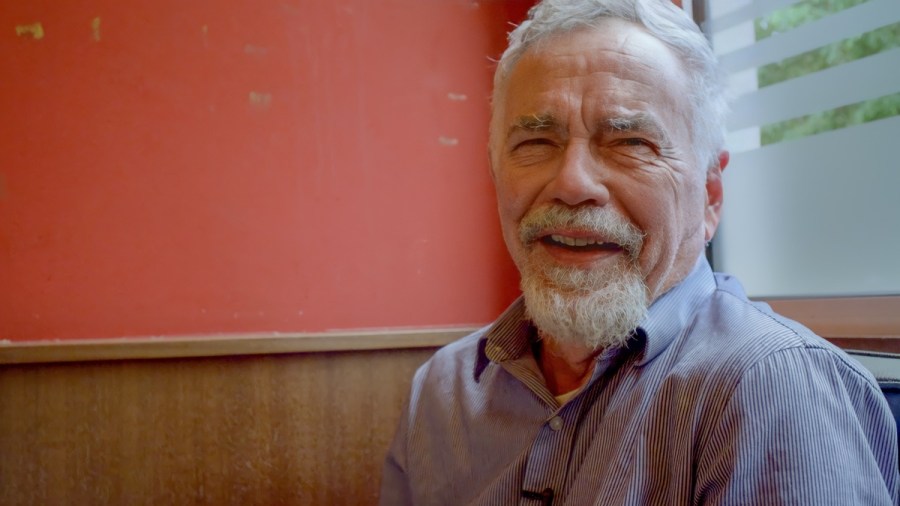
This visionary scientist revolutionized our understanding of evolution, laying the foundation for theories that ultimately explain cooperation, conflict, and deception across the natural world. His work has shaped entire fields, earning him the highest accolades in biology. His insights have transformed not only biology, but also medicine, psychology, and even political theory. No, I’m not talking about Charles Darwin; I’m talking about Robert Trivers— the most influential biologist you’ve probably never heard of.
In Wild Genius, filmmaker Susan Kucera and executive producer Jim Swift peel back the layers of Robert Trivers’ life and work, revealing a man whose brilliance is matched only by his wild lifestyle. More than a mere recounting of scientific achievements, Kucera’s documentary immerses viewers in the raw, unfiltered world of a genius who defied academic convention, championed political activism, and has lived life to the fullest.
Kucera’s journey into Trivers’ mind began in an unexpected place. While filming a documentary in Germany, a philosopher friend asked her if she had ever interviewed him. “I didn’t even know who he was,” Kucera admits to me during our interview for this review. That changed when she read The Folly of Fools, Trivers’ classic book on the evolutionary logic of lying and deceiving ourselves. “It changed so much about how I understood my relationships. I was going through a divorce at the time, and it explained a lot of my motivations and those of other people around me. So much so that I was in tears—it was almost a relief—understanding how people operate and how we might be unaware of the root causes of our behaviour. It gave me empathy for myself, my ex-husband, and others.”
The impact of Trivers’ theories on the scientific enterprise, and the influence he’s had across several generations of scientists, cannot be overstated. His concept of reciprocal altruism cracked the conundrum of why animals, including us humans, help one another, despite the steep costs involved (by crunching the evolutionary math behind ‘if you scratch my back, I’ll scratch yours’). His parental investment theory reshaped our understanding of sex differences across the animal kingdom, and why the sex that invests more in their offspring tends to be more selective of their sexual partners, forcing members of the other sex to compete against one another (which is why you’re more likely to see straight men starting a fight on a night out, but in the seahorse world, where males carry the pregnancy, it’s the females who do most of the fighting). Trivers’ theory of self-deception, arguably his most captivating idea, reveals why lying to ourselves is not a flaw, but rather, an adaptive feature of the human psyche.
In 2007, Robert Trivers received the Crafoord Prize, awarded by the Royal Swedish Academy of Sciences for “his fundamental analysis of social evolution, conflict, and cooperation.” Often regarded as the Nobel Prize equivalent for biology, this award cemented Trivers’ status as one of the most influential thinkers in the life sciences. As Steven Pinker boldly proclaims in Wild Genius, “I think Robert Trivers is one of the greatest thinkers in the history of the Western intellectual tradition because he gave elegant answers to fundamental questions of the human condition.” Echoing this sentiment, evolutionary anthropologist Robert Barton reflects on Trivers’ extraordinary intellectual streak: “Bob Trivers seemed to have what sports writers refer to as a rich vein of form in the early-to-mid 70s, in which he produced this string of phenomenal papers which laid the groundwork for thinking across large swathes of evolutionary biology.”
But Trivers’ life story isn’t just one of scientific accomplishments— it’s also one of chaos. Robert Trivers has been branded the ‘bad ass of evolutionary biology’, and for good reason. In his autobiography, A Wild Life (which I reviewed back in 2016), Trivers served a potent cocktail of near-death experiences, the times he’s arrested and thrown in jail, and his penchant for smoking marijuana. Infused with Trivers’ use of Jamaican slang, at times I thought I was not actually reading about the life of a Harvard scholar, but one of a dancehall star.
Trivers’ deep love for Jamaica is central to his life story. Known locally as the ‘Lizard Man’ due to his research on reptiles, he spent over 18 years in the Caribbean, where he has married twice and raised five children. Jamaica, however, is not always a peaceful retreat; it’s a place where Trivers has had to fight for his safety.
In Wild Genius, Susan shines a light on Trivers’ extraordinary scientific accomplishments, and how his research ultimately explains the existence of cooperation and altruism. The film, however, does not shy away from the dangers he has encountered. When Kucera arrived in Jamaica to film, she got a taste of this world firsthand. “The first thing Robert asked me was, ‘Do you have a gun?’” she shared with me. Just weeks before, machete wielding burglars had broken into his house, which, by miracle, and sheer bravery, he was able to fend off. “When I pulled the sucker on them”, Trivers retells, “they never guessed that this old fair skinned man would draw down on them.”
Susan also conveys Trivers’ lighthearted nature, including his reflections on the painful ironies of studying self-deception. As Susan shared with me; “He once told me how he was walking next to a woman, trying to catch her attention, and he saw an old man reflected in a window. He wondered who it was, then realized it was himself. It’s an example of self-deception—seeing yourself as younger or more attractive than you really are.”
In his signature combative style, Trivers doesn’t pull punches when it comes to psychology. In Wild Genius, he recalls taking a psychology class as a senior at Harvard, describing the discipline as “a series of incorrect guesses about human development.” Unlike Sigmund Freud, who theorized about unconscious drives and neuroses, Trivers sought to ground human behaviour in rigorous evolutionary calculus. Although psychology has made giant strides since the days of Freud, it still sorely lacks a unifying theoretical framework. Trivers has advanced the field by replacing vague notions of the subconscious with testable theories about lying and self-deception.
Brilliance often comes at a price, and Trivers appears to have paid dearly. “After writing one of his seminal papers, he would have a breakdown”, Sarah Blaffer Hrdy is filmed saying. “It was like a shaman diving into himself for insights, that we were all benefiting from, but at great personal cost.” Trivers’ struggles with mental health began in college, where doctors diagnosed him with schizophrenia. Later, some suspected bipolar disorder. Whilst the relationship is surely complicated, one can speculate that Trivers’ struggles with mental health, however painful, have helped him discover unique insights about the human mind.
Regrettably, evolutionary psychology is often mischaracterised as justification for the status quo. However, Trivers’ involvement with the Black Panther Party, covered intimately in Wild Genius, challenges the notion that evolutionary psychology is inherently right wing or fatalistic. His activism demonstrates that understanding our evolutionary roots doesn’t mean accepting them as destiny. Rather, uncovering the origins of our tribalistic tendencies can be a powerful tool for change. As Laurie Santos asserts, “I think if we really want to understand human nature and improve on it, we have to understand it well in all its foibles. If there’s stuff that’s built into our phylogeny that we don’t like, we might not like it. We still have to understand it. That’s the only way we’re going to overcome it.”
The film’s exploration of self-deception isn’t limited to academic curiosity. Flashes of disgraced business leaders in Wild Genius draws a direct line between Trivers’ theories and the ethical lapses of high finance. Through compelling shots, the documentary highlights Bernie Madoff’s Ponzi scheme and Sam Bankman-Fried’s cryptocurrency downfall, showing how self-deception operates at the highest levels. Whilst Bernie Madoff comes across to me as a cold-hearted psychopath who knew exactly what he was doing, Sam Bankman-Fried’s championing of ‘effective altruism’ appeared genuine. Perhaps self-deception got the better of Bankman-Fried, where the misappropriation of funds was rationalised as a stepping stone on the long path of solving the world’s most pressing problems? Trivers’ theory of self-deception warns us that those at the top may not just be lying to us—they may be lying to themselves as well.
Trivers’ legacy is one of intellectual revolution. He has defied academia, courted controversy, and reshaped how we understand ourselves. Wild Genius captures the essence of a man who has walked a tightrope between brilliance and chaos; a visionary scientist who, despite his blind spots, has helped us see further than we ever thought possible.
Written by Max Beilby for Darwinian Business. For more information about the documentary, including where to watch it, please visit wildgenius.org.
 Darwinian Business